

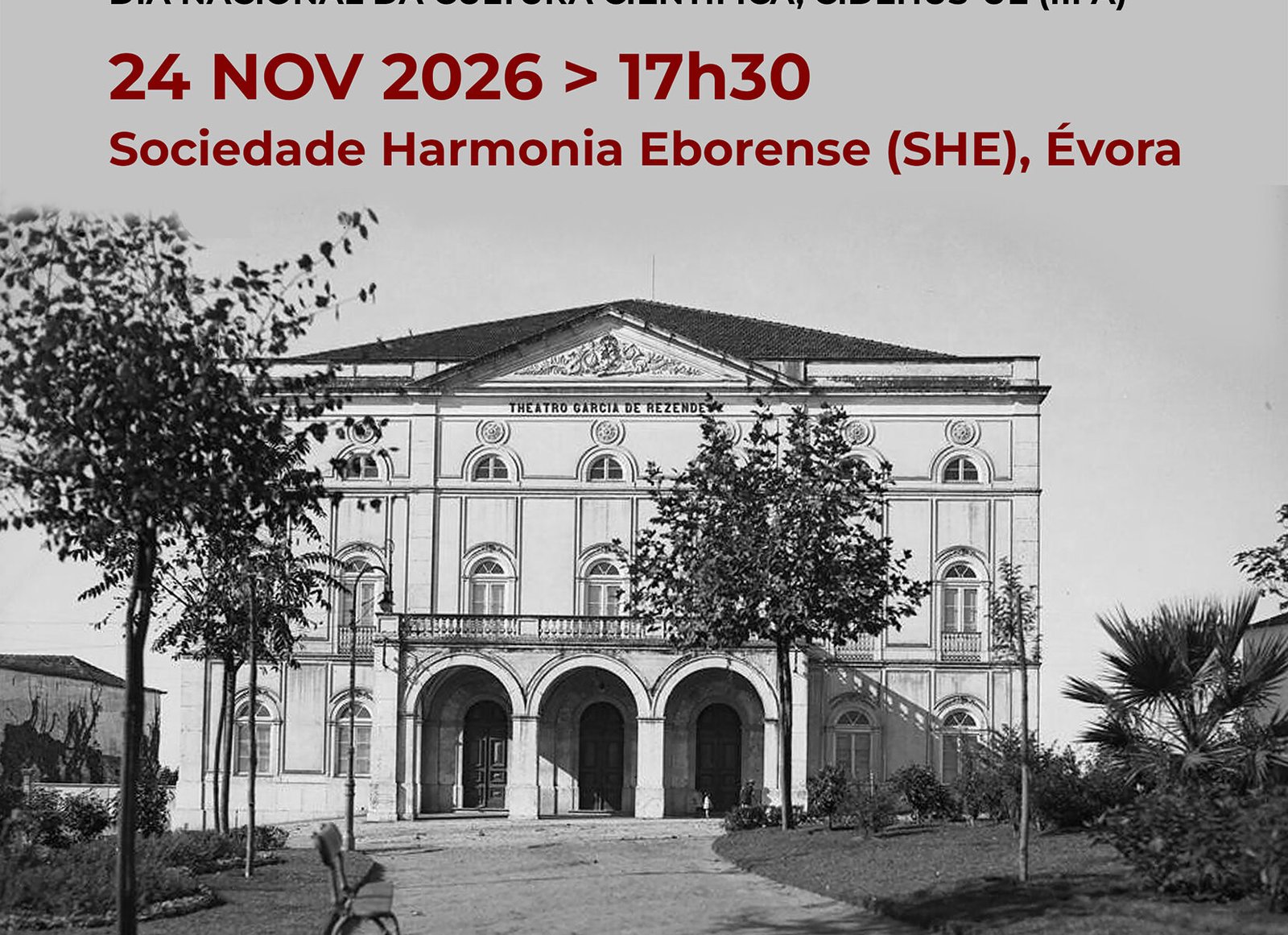
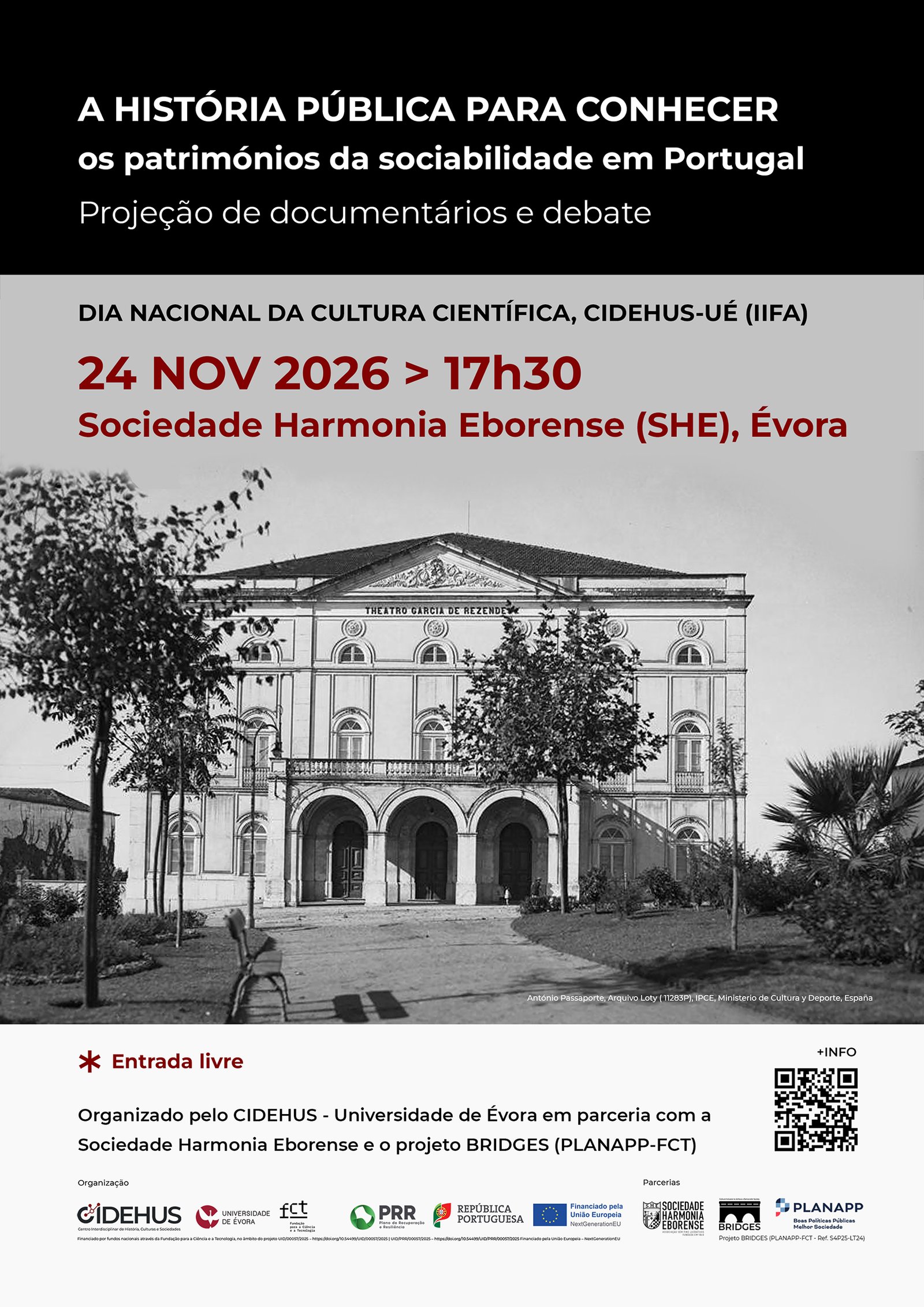
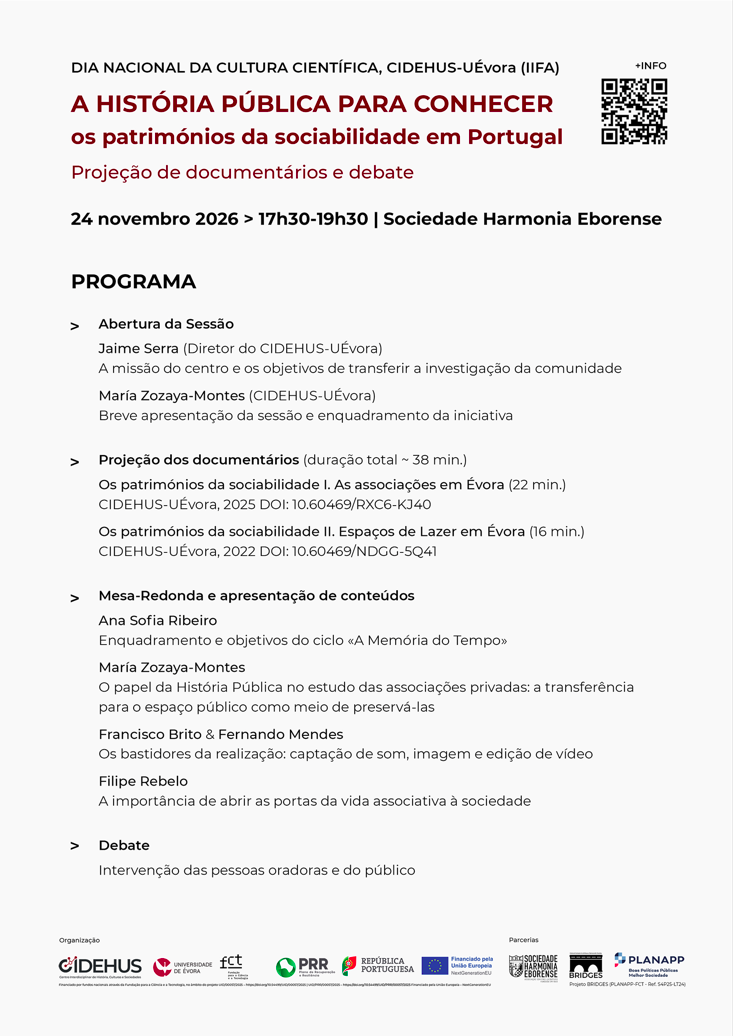
 Public History as a means to explore the heritage of sociability in Portugal: Documentary screenings and discussion.
 This initiative bridges academic research with the practices of Public History. According to Paula Hamilton and James Gardner (2017), this is a vast and dynamic field that combines the rigour of historical research with collaborative work developed with and for the public. This professional practice is characterised by being both analytical and active, linking fieldwork with in-depth conceptual reflection on memory, heritage, and the “sharing of authority.”
Today, the discipline consistently calls for openness and community participation, situating itself within an intellectual framework that is increasingly democratic, technological, and transnational. Driven by the digital revolution and growing global mobility, it leverages new technologies and diverse multimedia resources to bring scholarly findings closer to the general public—a goal served effectively by academic blogs, video podcasts, documentaries, and a broad digital landscape ranging from augmented reality to video games. Through these various channels and media, Public History expands the understanding of the past beyond strictly local or national boundaries, fostering the direct involvement of communities in the preservation and interpretation of their own history (Hamilton & Gardner, 2017).
In this context, Public History is understood as the production of historical knowledge in digital formats and the communication of this knowledge outside the strictly academic sphere—engaging in direct dialogue with the communities that hold these memories. By transforming archival materials and oral histories into accessible audiovisual content, the project seeks to return the tangible and intangible heritage of recreational and cultural associations to the public, actively contributing to its safeguarding, appreciation, and transmission to future generations.
In this sense, the past can be revisited, allowing for new interpretations and meanings to emerge regarding the subjects being explored. As Rafael Zurita Aldeguer (2020: 219) has pointed out, this type of historical representation imbues public space with collective value and meaning; over time—as we move further away from the foundational moments—these realities take on new interpretations for the community.
In the session on the 24th, the screening of documentaries produced by CIDEHUS (Zozaya-Montes, 2022; 2025), followed by a discussion, fosters new interpretations rooted in the reappropriation of the past—drawing on the meaning that this past regains for the community in the present—by valuing these forms of local heritage, in line with the principles of the Porto Santo Charter (2021).
- Target Audience: General public, youth, adults, seniors, researchers, cultural programmers.
- Day: 24th of September 2026
- Time: 17.30
- Duration: 120 min
- Location : Sociedade Harmonia Eborense, SHE
- Registration: free entry
- Notes: Film projection followed by debate with organizer Maria Zozaya Montes. CIDEHUS (Universidade de Évora), em parceria com a Sociedade Harmonia Eborense (SHE) e o projeto BRIDGES (PLANAPP-FCT).